
Spiti Valley Travel Guide: How to Experience the Valley Beyond the Usual Road Trip
Most people arrive in Spiti Valley with a list of viewpoints. Within a day or two, the list usually stops mattering.
Spiti sits in the rain-shadow of the Himalayas in Himachal Pradesh — a high-altitude cold desert of bare mountains, glacial rivers and villages that have been built around scarcity for centuries. It is not simply another Himalayan sightseeing destination to check off. The roads are long and often rough. Settlements are far apart. Monasteries here are still lived-in religious communities, not museum pieces. Weather and road conditions change the plan more often than any itinerary admits.
That is precisely what makes Spiti Valley worth understanding properly before you go. This guide is less about what to photograph and more about how to actually travel through it — where the road demands respect, where slowing down changes the experience entirely, and where the valley rewards patience over pace.
Spiti Valley at a Glance
| What to know | Details |
|---|---|
| Best time to visit | Broadly mid-June to early October for the full road-trip experience; shoulder months and winter offer a very different, more demanding kind of visit (see the Best Time section below) |
| Ideal duration | A comfortable first visit generally needs 6–8 days from Shimla or Manali; shorter trips are possible but leave little room for altitude adjustment or flexibility |
| Main gateways/routes | Via Shimla–Kinnaur (Narkanda, Kalpa, Nako) or via Manali (Atal Tunnel, Kunzum Pass) — each with a very different road character |
| Altitude character | A genuine high-altitude destination throughout — the valley floor, villages and passes sit at elevations where acclimatisation matters, roughly in the 3,000–4,500+ metre range depending on where you are |
| Best for | Road-trip travellers, photographers, culturally curious travellers, and anyone drawn to remote, quiet landscapes |
| Travel style | Slow travel and self-drive/road-trip style suit Spiti best; rushed, checklist-style sightseeing works against the experience |
| Must-experience regions | Key Monastery and Kibber, the Dhankar plateau, Tabo, and — route and season permitting — Chandratal |
| Road-trip considerations | Long driving days, sections of unpaved or weather-affected road, limited fuel stations, and mountain-pass routes that are seasonal, not year-round |
Why Spiti Is Different From a Typical Himalayan Road Trip
A lot of Himalayan road trips can be compressed without losing much. Spiti resists that.
The landscape itself sets the pace: long stretches between villages, roads that climb and drop with the terrain, and a general remoteness that means help, fuel and phone signal are not always nearby. Altitude adds a second layer — much of Spiti sits high enough that rushing between elevations can genuinely affect how a traveller feels, not just how tired they are.
Weather changes plans here more than in most Himalayan regions. A landslide, a snowfall out of season, or a swollen stream crossing can close a route for hours or days, and a rigid itinerary tends to break at exactly the wrong moment. The monasteries, too, are not backdrop — they are active communities of monks following their own daily rhythm, and visiting them well means slowing down enough to actually be there, rather than photographing the entrance and moving on.
At Magna Voyagee, this is the starting point for how a Spiti itinerary gets built: don’t just collect viewpoints. Give yourself time to experience the valley.
7 Experiences That Make a Spiti Valley Journey Special
1. Explore Key Monastery, and give it more than a drive-by
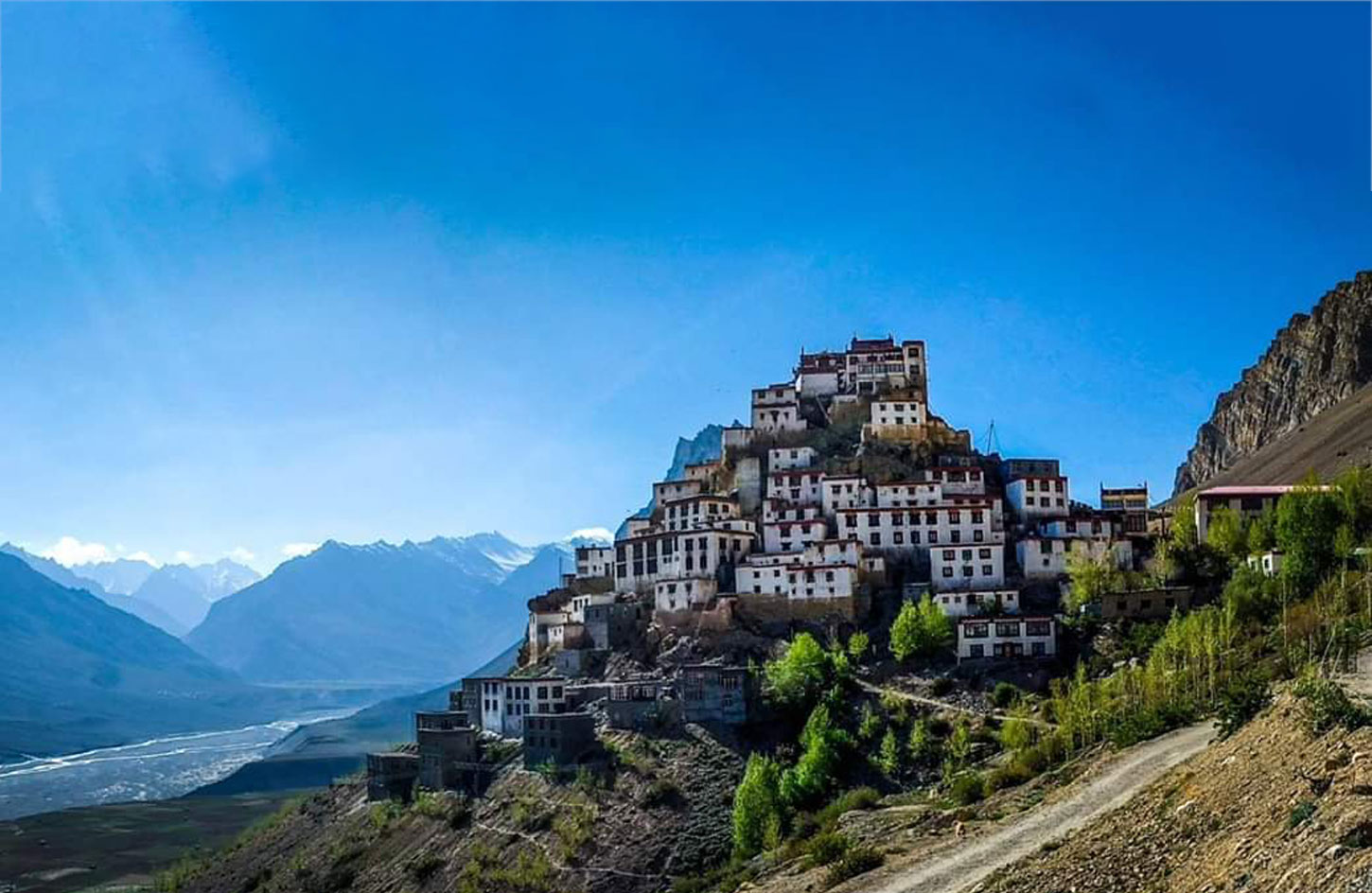
Key (also spelled Ki or Kye) is the largest monastery in Spiti, its whitewashed buildings stacked against the hillside in a way that looks almost sculpted from it. It is easy to treat as a photo stop from the road below. It is far more rewarding as a place to actually walk through — the prayer halls, the murals, the quiet courtyards where monks go about ordinary routines. Arriving without rushing, and being genuinely respectful of it as an active monastery rather than a tourist attraction, is what turns a five-minute stop into a real experience.
2. Experience the remote village landscapes of Spiti
Between the named sights, Spiti is made up of small villages — flat-roofed stone-and-mud houses, barley fields in short, intense green against grey mountains, prayer flags moving in the wind. These in-between places rarely make an itinerary by name, but they are where the character of the valley actually lives. Slowing the drive down, stopping without a specific reason, and simply being present in a village for a while often ends up as the part of the trip travellers remember most.
3. Visit Kibber and the high-altitude villages
Kibber sits among the highest permanently inhabited villages anywhere, considerably higher again than Kaza below it. The air is thinner here, the horizon wider, and the sense of remoteness sharper. It’s also close to Kibber Wildlife Sanctuary, part of the snow leopard habitat that Spiti is known for among wildlife researchers — sightings are rare and never guaranteed, but the landscape itself explains why this terrain suits an animal built for exactly this kind of high, empty country.
4. Discover Dhankar and its dramatic setting
Dhankar was once the historical capital of Spiti, and its monastery and village are built directly onto a spur of rock that drops away on either side toward the valley below. The setting alone explains why this location was chosen centuries ago — it offered a clear view up and down the valley in an era when that mattered for survival. A short walk up from the monastery to the small lake above Dhankar adds a quieter, less-visited perspective on the same landscape.
5. Spend time around Tabo and its ancient monastic heritage
Tabo Monastery dates back over a thousand years and is sometimes described as the Ajanta of the Himalayas for its murals and stucco work, still remarkably intact given their age. Tabo sits lower and gentler than much of Spiti, which also makes it a sensible place to spend a night while the body adjusts to altitude. The monastery rewards a slow, unhurried visit — the murals are best appreciated in low light, without rushing from one chamber to the next.
6. Experience Chandratal when the route and season allow
Chandratal — the “Moon Lake” — sits at a high, remote altitude near the Kunzum Pass side of the valley, and its crescent shape and shifting colours through the day are genuinely striking. It is not accessible year-round; the approach depends on snow clearance and road status, which is exactly why it belongs on this list as an experience to plan around rather than assume. When conditions allow, an early morning or evening at the lake, away from the midday crowd of day visitors, is worth building extra time for.
7. Slow down and experience the everyday landscape of Spiti
Some of the best moments in Spiti aren’t a monastery or a lake at all — they’re the drive itself. A river running turquoise against bare rock. Light changing on a mountain face over an hour. A cup of tea in a small village dhaba while a herd of goats crosses the road. None of this photographs as a “sight,” but it is arguably what defines Spiti more than any single stop on the map.
What Most Travellers Get Wrong About Spiti Valley
Spiti has become popular enough that certain mistakes repeat themselves trip after trip. Most are avoidable with a bit of planning.
- Trying to cover Spiti too quickly. A weekend-length trip squeezed around long travel days leaves almost no room for the valley itself — most of the time ends up spent in the vehicle.
- Underestimating road travel. Distances on a map look short; actual driving time in the mountains is longer, and road conditions can add hours without warning.
- Ignoring altitude and acclimatisation. Climbing too high, too fast is one of the most common reasons trips get cut short — see the acclimatisation section below.
- Planning only around photographs. An itinerary built purely around “photo spots” often skips the villages, monasteries and slower moments that give Spiti its actual character.
- Expecting constant mobile connectivity. Coverage is patchy across most of the valley — planning as if you’ll always have signal leads to avoidable stress.
- Treating every day as a sightseeing checklist. A packed daily list works against a landscape that rewards unhurried time.
- Not allowing flexibility for weather and road conditions. A rigid, back-to-back itinerary breaks the moment one road closes for a few hours — and in Spiti, that happens.
How Many Days Do You Need in Spiti Valley?
The honest answer depends on how you want to travel, but a few broad bands are useful for planning.
A short trip of around 4–5 days is possible, usually entering and exiting from the same side (typically Shimla–Kinnaur), covering Kaza, Key, Kibber and Dhankar. It’s tight, and leaves little buffer for weather or altitude, but it can work for travellers with limited time who understand the trade-off.
A comfortable first-time trip generally runs 6–8 days, allowing a night in Kinnaur on the way in for gradual altitude gain, proper time in Kaza and the surrounding villages, and a realistic buffer for road conditions. This is the range Magna Voyagee typically recommends for a first Spiti journey.
A slower, extended trip of 9–12 days or more allows both entry routes to be used (Shimla–Kinnaur in, Manali out, or the reverse), unhurried time in multiple villages, a real chance at Chandratal if conditions allow, and enough flexibility that a single bad-weather day doesn’t derail the whole plan.
For travellers who want to actually experience Spiti rather than rush through it, 7–8 days is a sensible, comfortable target.
Suggested Spiti Valley Itinerary
This is a practical route structure, not a fixed timetable — exact drive times, road conditions and pass status vary by season and year, so treat the day count as a planning guide rather than a guarantee.
- Day 1 — Shimla to Kalpa/Kinnaur region (route/drive day). A long but scenic drive along the Sutlej valley, gaining altitude gradually — an intentional first step toward acclimatisation.
- Day 2 — Kinnaur to Kaza, via Nako and Tabo (route day with stops). Nako’s small lake and village make a good midway break; a visit to Tabo Monastery en route is worth real time, not a quick stop.
- Day 3 — Kaza, with a side trip to Dhankar (acclimatisation and sightseeing). A lighter day by design, allowing the body to settle at altitude while still covering Dhankar’s monastery and viewpoint.
- Day 4 — Kaza to Kibber and Key Monastery (monastery and village experiences). A full day dedicated to Key and the high villages around Kibber, without rushing between them.
- Day 5 — Chandratal, route and season permitting (sightseeing, weather-dependent). Build in flexibility here — if the route or weather doesn’t allow it, this day can shift to further exploring Kaza’s surrounding villages instead.
- Day 6 — Onward via Kunzum Pass toward Manali, or back via Kinnaur (route/drive day). Which direction depends on the route you entered from and current road/pass status.
- Day 7–8 — Buffer and return. A deliberate cushion for weather, road closures, or simply wanting one more slow day somewhere along the way, before the drive back to Shimla or Manali.
A private vehicle with a driver familiar with these roads makes this kind of flexible itinerary considerably easier to manage than a fixed group schedule.
Best Time to Visit Spiti Valley
There is no single universally “best” month for Spiti — it depends on the route and the kind of experience you want.
Summer road-trip season (roughly mid-June through September) is when both major routes are typically motorable, including the Manali side via Kunzum Pass, and when Chandratal is most likely to be accessible. This is the most popular and most reliable window for a first visit, though it’s also when the roads see the most traffic.
Shoulder periods — early June or October — can offer quieter roads and striking light, but come with more uncertainty: the Manali-side route may not yet be (or may no longer be) open, and weather can shift faster than in peak summer.
Winter Spiti is an entirely different experience — a snow-bound, largely isolated landscape reachable in practice only via the Shimla–Kinnaur side, with very limited services and serious cold. It appeals to a specific kind of traveller comfortable with real hardship and unpredictability, not a typical road-trip visit.
For most travellers planning their first Spiti journey, the summer window offers the most reliable balance of accessibility and experience — but exact road-opening dates vary year to year and should be checked closer to travel.
How to Reach Spiti Valley
There are two established approaches into Spiti, and they offer genuinely different experiences.
The Shimla–Kinnaur side runs via Narkanda, Rampur, Kalpa and Nako before reaching Tabo, Dhankar and Kaza. Roads on this side are generally in better condition and the altitude gain is more gradual, which is why this route is usually recommended as the entry point, particularly for a first visit or for anyone concerned about altitude.
The Manali side crosses via the Atal Tunnel and Kunzum Pass, a shorter but more rugged route with steeper, more dramatic terrain and a faster altitude gain. It tends to work better as an exit route after a few days of acclimatisation in Spiti, or for travellers already comfortable with high-altitude mountain driving.
Road conditions and permit requirements on both sides can change with the season and with local administrative decisions, so it’s worth confirming current status — particularly pass-opening dates on the Manali side — close to your actual travel dates rather than relying on older information.
Altitude, Acclimatisation & Travel Comfort
Spiti is a genuinely high-altitude destination, and altitude deserves real planning, not an afterthought.
The most practical approach is to gain elevation gradually rather than jumping straight to the highest points. Spending a night at a moderate altitude early in the trip — Kinnaur, or lower-altitude Tabo — before pushing on to Kaza and the higher villages gives the body time to adjust. Rushing straight to Kibber or Kunzum Pass on day one is one of the more common reasons a trip gets disrupted.
Hydration, rest and pacing matter more here than they might elsewhere. Drinking more water than usual, avoiding overexertion in the first day or two at altitude, and building rest into the itinerary rather than treating every day as go-go-go all help.
Travellers with relevant medical conditions — heart, lung, or other conditions that could be affected by high altitude — should consult a qualified medical professional before travelling, and discuss any altitude-specific precautions or medication in advance. This guide offers general, responsible travel planning advice, not medical guidance.
What to Pack for Spiti
- Layered clothing — temperatures swing significantly between day and night, and between sun and shade
- A warm jacket, even in summer months
- Comfortable, broken-in shoes suited to uneven ground
- Sunglasses — the high-altitude sun is intense
- Sunscreen, applied more often than you’d expect
- Lip balm and moisturiser — the dry mountain air is harsh on skin
- A reusable water bottle
- A power bank, since charging points aren’t always readily available
- Any basic personal medicines you rely on, plus a small general first-aid kit
- A small day backpack for monastery visits and short walks
- Cash in reasonable amounts (see the next section)
- Offline maps and any important documents downloaded in advance
Mobile Network, Internet & Cash
Connectivity across much of Spiti is limited, and it would be unrealistic to promise reliable signal or data anywhere specific — coverage varies by location, network provider and even time of day, and it changes over time. The safer approach is to plan as though you’ll be offline for stretches of the trip.
Carrying some cash is genuinely useful, since card and UPI payments aren’t guaranteed to work everywhere. Downloading offline maps before you leave network coverage, saving copies of important documents (ID, bookings, permits if applicable) to your phone, and carrying a power bank are all sensible, low-effort precautions that make the patchy-connectivity reality much less stressful in practice.
Is Spiti Valley Suitable for Families?
Spiti can work for families, but it suits some family setups better than others. The long drives, altitude, and occasionally rough road conditions are real considerations — a full day in the car is a different experience for a young child than for an adult who chose to be there.
Families travelling with young children or older relatives generally do best with a private vehicle rather than a fixed group schedule, a slower pace with fewer destinations per day, and realistic expectations about basic comfort levels in more remote stretches of the valley. Families comfortable with that kind of trip — and willing to build in extra rest and buffer days — often find Spiti a genuinely memorable experience precisely because it’s unlike a typical family holiday.
Is Spiti Good for Couples?
Spiti works well for couples who want something quieter and more remote than a conventional getaway — long drives together, small guesthouses in villages, monasteries with real silence in them, and landscapes that reward simply sitting and looking rather than doing. It suits couples drawn to photography, slower travel, and conversation over a long drive more than couples looking for resort-style comfort or a packed activity list. The remoteness itself tends to be the appeal, rather than anything staged around it.
Spiti Valley Trip Cost: What Determines Your Budget?
Spiti’s cost varies considerably depending on how you travel, and there isn’t a single “typical” number worth quoting — the honest answer is that your budget is shaped by several factors together.
- Number of travellers — a private vehicle and driver cost the same whether shared by two people or six, so group size changes the per-person cost significantly
- Accommodation category — from simple homestays to more comfortable guesthouses and hotels, options span a wide range
- Private vehicle vs. shared transport — a dedicated vehicle offers far more flexibility, at a higher cost than shared options
- Route chosen — a single-entry/exit route is generally more economical than a longer loop covering both sides
- Trip duration — more days naturally means more accommodation and vehicle cost, offset by a less rushed experience
- Season — peak summer months typically see higher demand and pricing than shoulder periods
- Activities and experiences included — monastery visits are generally free or low-cost, but add-ons like specific treks or wildlife excursions carry their own cost
- Any applicable permits — relevant primarily for foreign nationals, who require a Protected Area Permit
- Getting to the gateway city — flights or trains to Delhi, Shimla or Manali before the road trip even begins
Because these variables shift so much from one traveller’s plan to another, Magna Voyagee builds Spiti itineraries around your specific group size, comfort expectations and route rather than working from a fixed package price.
Who Is a Spiti Valley Road Trip Best For?
Spiti tends to suit travellers who genuinely enjoy road trips rather than tolerate them, who are drawn to mountains and remote landscapes over resort comfort, and who appreciate photography, monasteries and quieter cultural experiences. Comfort with long drives and a degree of unpredictability — in weather, in road conditions, in the day’s plan — matters more here than in most Himalayan destinations.
Travellers who prioritise fixed schedules, guaranteed connectivity, or five-star comfort at every stop may find Spiti more demanding than rewarding, and might be better suited to a different Himalayan region or a more heavily infrastructured itinerary. That isn’t a judgment on either kind of traveller — it’s simply a matter of matching the destination to what you actually want from a trip.
Frequently Asked Questions
How many days are enough for Spiti Valley?
A short trip is possible in 4–5 days, but a comfortable first visit generally needs 6–8 days to allow for altitude adjustment and some flexibility in the itinerary.
What is the best time to visit Spiti Valley?
Roughly mid-June to September is the most reliable window for a full road-trip experience, though the right time also depends on which route you plan to take and how much unpredictability you’re comfortable with.
Is Spiti Valley safe for first-time travellers?
Spiti is a well-established travel route, but it is remote, high-altitude, and road conditions can be unpredictable. First-time travellers generally do best entering via the Shimla–Kinnaur side for a gentler altitude gain, planning conservatively, and staying flexible around weather and road status.
Which route is better for Spiti Valley?
The Shimla–Kinnaur side is generally considered the gentler, more reliable entry route due to better road conditions and gradual altitude gain. The Manali side, via Kunzum Pass, is more rugged and seasonal, and often works better as an exit route once you’re already acclimatised.
Is Spiti suitable for families?
It can be, particularly with a private vehicle, a slower pace, and realistic expectations about long drives and basic comfort levels in remote areas. It suits families open to that kind of trip more than those expecting a conventional holiday pace.
Do you need a private vehicle in Spiti?
A private vehicle offers considerably more flexibility for a region where plans often need to adjust around weather and road conditions — most travellers find it makes a meaningful difference to comfort and pacing.
Is mobile network available in Spiti Valley?
Coverage is patchy and inconsistent across much of the valley. It’s sensible to plan as though you’ll be offline for stretches of the trip rather than rely on continuous connectivity.
Is Spiti Valley suitable for senior citizens?
It can be, for travellers in good general health and comfortable with long drives at altitude, ideally with a private vehicle, a slower itinerary, and gradual acclimatisation built in. Anyone with relevant medical concerns should consult a doctor before travelling.
What should I pack for Spiti Valley?
Layered warm clothing, comfortable shoes, sun protection, a power bank, a reusable water bottle, basic personal medicines, and offline maps or downloaded documents are among the genuinely useful essentials — see the full packing section above.
Is Chandratal accessible throughout the year?
No. Access to Chandratal depends on seasonal road and weather conditions and is not guaranteed year-round — it’s best treated as an experience to plan around rather than a fixed stop, with current route status confirmed closer to your travel dates.
Spiti Valley is not a destination you need to rush through.
The mountains, monasteries, villages and long Himalayan roads become part of the experience when you leave enough space in the itinerary to actually experience them.
At Magna Voyagee, we design customised Spiti Valley journeys around your travel style — whether you want a comfortable private road trip, an adventure-focused itinerary, meaningful monastery experiences, family-friendly travel or simply more time in the mountains.
Don’t just visit Spiti Valley.
Give yourself time to experience it.
Plan Your Spiti Valley Journey with Magna Voyagee
Enquire for a Customised Spiti Valley Itinerary
Written by the Magna Voyagee Travel Team | Destination specialists in customised journeys